
SEBI Investor-information/assistance: SEBI Investor Website is aimed to help an individual to take control of money so that it can lead to better outcome in his/her investment journey.
The website offers guidance to individuals to manage their money well and make sound financial decisions on their own.
We believe that financial awareness topics, tools, and calculators can help people of all ages, backgrounds, and incomes to be in control of their financial decisions. Through the SEBI Investor website, we promote confident and informed participation by investors in the securities market.
Apart from resources published on the SEBI Investor Website, SEBI, in association with Stock Exchanges, Depositories, and other stakeholders such as the Association of Mutual Funds (AMFI), conducts investor awareness programs across India for the public.
These awareness programs cover a wide range of topics, ranging from money management, personal finance, and securities market investment.
These programs help participants understand their own financial needs, decide which financial products are right for them, and empower them to make informed financial decisions.
SEBI associates with individuals/organizations working in the field of investor education for conducting awareness programs.
Interested in associating with SEBI as a Trainer in Securities Market? Partner with SEBI
MCX IPF - SEBI registered Financial Influencer - YouTube
In case of any further information/assistance required, Investors may contact us at:
Investor Awareness Division,
Office of Investor Assistance and Education (OIAE),
SEBI BHAVAN 2, Plot No. C-7, ‘G’ Block, Bandra Kurla Complex,Bandra(E), Mumbai - 400 051, Maharashtra
Email: feedback@sebi.gov.in
What is Saving?
Saving means setting aside of a certain portion of income to meet future financial requirements. Saving is what remains from income after expenses, which can be calculated as income minus expenses.
Saving = Income - Expenses
Saving is important for securing an individual’s financial well-being, achieve long-term goals and financial security. It also provides a sense of peace of mind.
It is often stated that “Don’t save what is left after spending, spend what is left after saving.”
Why We Save
There is no right time to start saving, the earlier we start the better.
Some key reasons why saving is important:

- Savings enable us to build an emergency fund to cover unexpected expenses, such as medical emergencies, business loss, etc.

- To meet financial goals such as buying a new house,to meet cost of higher education of children, planning for retirement and so on.
To know more about savings, please watch the following video:
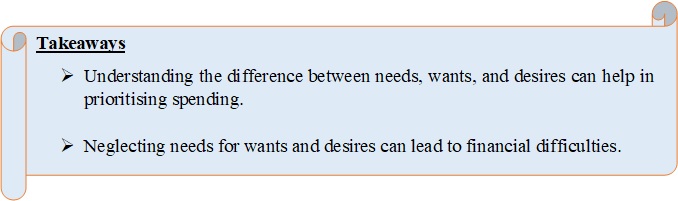
In order to prioritize your spending and increase your savings, it is essential to understand the difference between needs, wants, and desires.
Needs:
Needs are necessary for survival. These are basic in nature. Examples of needs include food, water, housing, clothing, healthcare, etc.
Wants:
Wants are not essential for survival, but enhance one’s lifestyle and comfort, such as, entertainment, dining out, vacations etc.

Desires:
Desires are strong aspirations like buying a dream luxury car, latest electronic gadgets like high-end mobile phones, etc. To satisfy desires, one may be tempted to borrow money (see the article Think Before You Borrow Money).
If we spend too much money on our desires or wants without prioritizing, budgeting and therefore saving may become difficult. Therefore, one should prioritize the allocation of money first towards needs and then towards wants and lastly toward desires without losing focus on saving.
To know more, please watch the following video:
Management of Income and Expenses
FOR MORE FINANCIAL LITERACY GO TO WEBSITE OF SEBI


No comments:
Post a Comment